Training Can Only Prepare: Rethinking the Kirkpatrick Model with Wendy Kayser Kirkpatrick
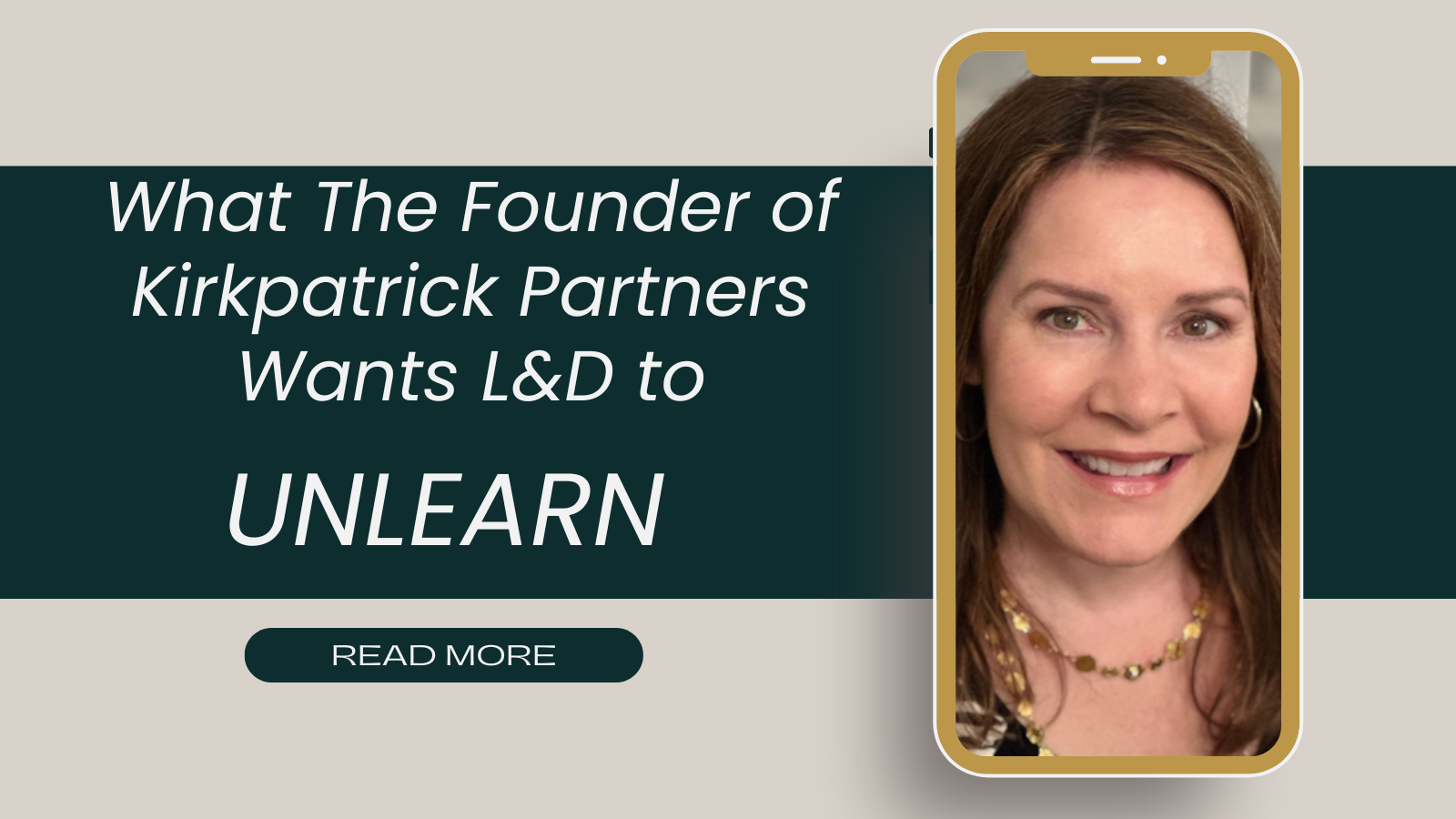
When the person who built the company behind the gold standard of training evaluation sits down to talk about the model, it is worth leaning in. On this episode of The Kirkpatrick Podcast, Vanessa Alzate is joined by Wendy Kayser Kirkpatrick — Founder of Kirkpatrick Partners, steward of the model for sixteen years, and author of the foreword to Vanessa’s new book, Building a Culture of Evaluation: The New Kirkpatrick Model for Performance and Innovation. What follows is part masterclass, part origin story, and part gentle correction of the habits that keep good teams from getting real results.
The Misconception That Costs the Most
Ask Wendy for the most damaging belief she still sees, and she doesn’t reach for something obscure. It’s the assumption that the four levels are sequential and equal — that a team should pour its energy into perfecting the Level 1 reaction sheet, then, only once that is flawless, move on to Level 2, and maybe, years down the road, get to the levels that actually matter: behavior and results.
As Wendy puts it, that approach is “kind of all backwards.” The model was never meant to be climbed like a staircase from the bottom. It was meant to be designed from the top. Start with the end in mind: name the results the organization needs, define the on-the-job behavior that produces them, and only then decide what learning and what reactions will support that behavior. Used that way, evaluation stops being a report card you fill out after the fact and becomes the blueprint you build from.
Evaluation Is Bigger Than Training
The second thing Wendy wishes people understood is that Kirkpatrick was never “just a little training evaluation model.” It drives organizational capability. The moment you stop treating training as an event and evaluation as the thing that happens afterward — and instead ask how training, performance support, and everything else in the organization work together to hit a goal — you are using the model the way it was always intended. Wendy is candid that many professionals still don’t see that holistic picture. Closing that gap is much of the work ahead.
Where the Model Came From
The origin story is a useful corrective to the checklist habit. Don Kirkpatrick developed the four levels while earning his PhD at the University of Wisconsin in the 1950s, studying supervisory training programs. He wanted an honest answer to an honest question: is the work I’m doing making a difference? Drawing on ideas from organizational psychologist Dr. Raymond Katzell, he assembled four dimensions for judging a program’s effectiveness. The world of the 1950s looked nothing like ours — training meant people in a room, talking — yet the core logic still holds perfectly today, whether someone is learning in a classroom or on their phone from the sofa. You learn something that helps you perform better, and better performance produces results.
So why did such a flexible idea get flattened into a survey framework? Partly by accident of publication. Don wrote four articles for what is now the Association for Talent Development, and they appeared in order: Reaction, Learning, Behavior, Results. People took that sequence literally. And partly by gravity: Levels 1 and 2 sit comfortably within the control of the L&D function, so they are simply easier to do.
Level 3 Isn’t Hard — It’s Where You Earn Your Seat
Wendy pushes back firmly on the idea that Level 3 is “hard.” It isn’t hard, she argues — it takes planning, creativity, and some good old-fashioned ingenuity. You may not be in the same room as the people who took the training, so you get inventive with the tools available and work through the barriers you find. “If there weren’t barriers to overcome,” she asks, “couldn’t we all just be replaced by bots?” Level 3, in her framing, is exactly where learning professionals show what they can do and earn their seat at the table.
Reinforce the Behavior You Want to See
There is a quieter thread running through the conversation, and it is easy to miss: reinforcement. Wendy admits she was never one to sit back and celebrate a success — she crossed a major revenue milestone in the early years of Kirkpatrick Partners and did not notice until she reviewed the financial statements months later. She offers it as a gentle cautionary tale, and then connects it straight back to the model. When people do the right things on the job — the behaviors that move an organization toward the result it needs — something as simple as timely recognition makes those behaviors far more likely to stick. It does not have to be grand. A word of praise in the moment, a small reward, a leader who notices. Level 3 is not only about designing for behavior and monitoring it; it is about actively encouraging and rewarding that behavior once it appears. Teams that treat reinforcement as optional often wonder later why a promising new skill quietly faded on the job. Teams that build it in tend to watch the change hold.
Who Actually Gets It Right
Asked who does evaluation well, Wendy points first to every branch of the U.S. military. In a highly structured environment where the stakes can be life and death, the training simply gets done — it is never quietly deprioritized when everyone gets busy. Corporations, by contrast, shine on agility: many can turn on a dime when the market shifts. The reassuring takeaway is that the model works in both worlds. No one is stuck in an environment where they can’t create value; it can be done in the most disciplined settings and the most fast-moving ones alike.
Vanessa names the pattern underneath: consistency and commitment on one side, agility on the other. She adds a hard-won observation of her own — evaluation fails when organizations send only their L&D staff to the workshop. Getting the learning team aligned is the easy part. The real work is getting the rest of the business in the room, so data can be shared and partnerships can be built.
Training Can Only Prepare
The line that lands hardest is Wendy’s restaurant analogy. Imagine a restaurant that trains only its servers to perfection while the host can’t seat guests and the kitchen can’t plate the food. No one loves that restaurant. Training one function well is never enough. From this comes the phrase Vanessa says she’ll borrow: training can only prepare people. It can build knowledge and skill, and support attitude, confidence, and commitment — but if the barrier to performance is something else, training was never going to be the whole solution. Framing training as preparation helps stakeholders outside L&D understand that it is the first step, not the finish line.
Why Strong Program Evaluation Isn’t Enough
It is entirely possible to run a beautifully evaluated training program and still fail to move the organization. Wendy’s restaurant makes the point vividly, and it generalizes: you can perfect one function and still lose the outcome if the surrounding system is not aligned. That is why program-level success does not automatically translate into organizational impact. A strong course, measured carefully at Levels 1 and 2, tells you the learning event worked. It says very little about whether the business goal was reached, because that goal also depends on managers, tools, incentives, and a performance environment training alone does not control. The remedy is not to evaluate less — it is to widen the lens. Partner with the business to define the performance that matters, prepare people for it, and then work together in the environment where that performance actually happens, reinforcing what is going well and steering what has drifted off course.
Where This Goes Next
Looking ahead, Wendy wants organizations to get out of their silos and work holistically from start to finish. In a world of rapid change, she argues, the differentiator is no longer knowledge but adaptability — and adaptability is just learning things quickly. That makes learning more central, not less, and it reframes the anxiety about AI. Rather than fearing that a bot will take the job, the opportunity is to broaden the role: build relationships across the organization and ask, in her words, “What are all the different ways I can be of service?” That, more than any single evaluation technique, is the future the model was built to serve.
Putting It Into Practice
If a single instruction captures the whole conversation, it is this: design backward and partner outward. Designing backward means starting every initiative with the result the organization needs, naming the on-the-job behavior that produces it, and only then deciding what learning and what conditions will support that behavior — the exact reverse of the checklist habit. Partnering outward means refusing to carry the result alone: bring stakeholders in early, agree on what success looks like, and stay involved in the performance environment long after the training event ends. Frame training honestly as preparation rather than a cure-all, reinforce the right behaviors the moment they appear, and treat adaptability as a capability worth building on purpose. None of this asks anyone to abandon the four levels. It asks us to use them the way they were always meant to be used — as a way to drive performance, not merely to document it.
Want to put this into practice? Explore the Kirkpatrick Model, certification programs, and free resources at kirkpatrickpartners.com.